
Development Models: Corporate Tribes vs. AI Swarms
From Human Synchronization to Agentic Orchestration: Scaling Without the Management Tax

Scaling an engineering organization traditionally requires a trade-off: increasing headcount to boost output, which inevitably raises communication overhead. In 2026, the Spotify Model of Tribes and Squads remains the corporate standard for managing this human synchronization. In the startup environment, the "Claude Code Swarm" has emerged as the primary alternative.
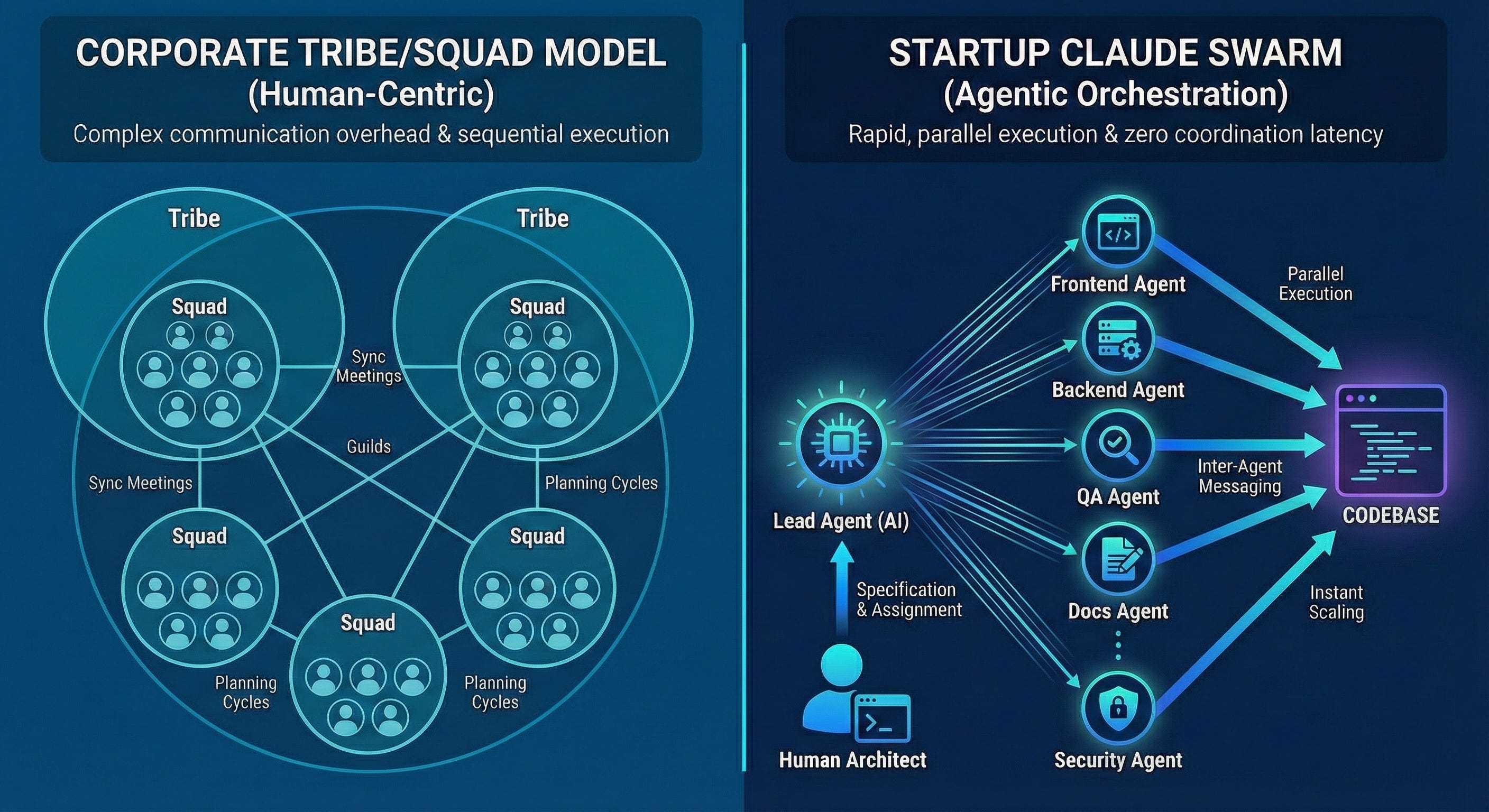
By deploying Claude Code agent swarms, a single human architect can manage a parallelized workforce that delivers the output of a full tribe without the associated “management tax” of meetings, syncs, and administrative layers.

Corporate: The Tribe/Squad Framework
Large-scale development relies on partitioning people to manage cognitive load and communication overhead.
Squads: Small, cross-functional teams (6–10 people) with end-to-end responsibility for a specific product feature.
Tribes: Collections of squads (40–150 people) working in related domains to ensure alignment without centralized micromanagement.
Chapters and Guilds: Horizontal layers used to maintain engineering standards and knowledge sharing across autonomous squads.
Bottleneck: Progress is limited by human synchronization—meetings, planning cycles, and hiring lead times.
In my 10 year long corporate career, I worked in this setup in several banks.
Coding itself has never been the problem. The alignment across the whole organization caused months long delays in every single one of these organizations.
Startup: The Claude Code Agent Swarm
Modern startups leverage multi-agent orchestration to replace traditional team structures. Instead of hiring specialists, a single founder or lead engineer manages a swarm.
Lead Agent: Orchestrates the high-level plan, delegates tasks, and synthesizes results.
Specialist Agents: Sub-agents (Frontend, Backend, QA, Docs) created on-demand. Each operates in an independent context window to maximize reasoning capacity.
Parallel Execution: Agents work in separate Git worktrees simultaneously. A feature that requires five files across three layers can be implemented in parallel rather than sequentially.
Efficiency: Swarms reduce “intent drift” by isolating tasks. Each agent focuses on a narrow scope, preventing the context window saturation common in single-agent development.
The Human Architect functions as the system's "Intent Engine," defining high-level specifications and business logic for the Lead Agent to decompose. Their primary responsibility shifts from managing people to architecting workflows and validating the swarm’s output against the product vision.
Comparative Analysis
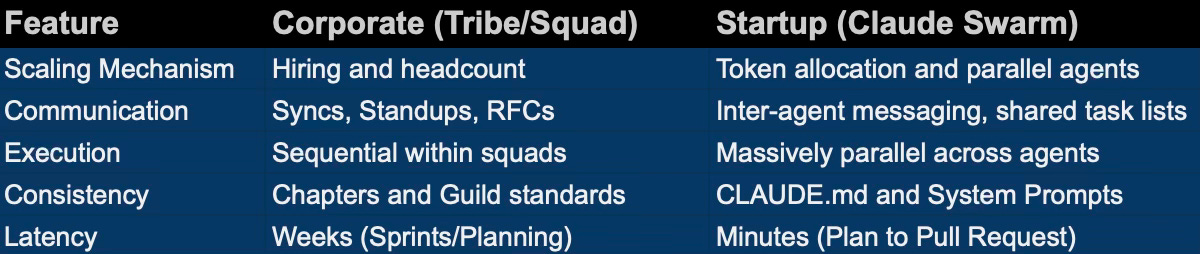
The Tribe/Squad model is designed to address Dunbar’s Number in human social groups. It assumes communication is the primary constraint.
The Claude Code Swarm model assumes context management is the primary constraint. By distributing a codebase across 20+ specialized agents, a startup can match the output of a corporate tribe without the management layer.
The role of the human transitions from Product Manager, Engineer, Designer to a Product Architect, who leads with the vision across all domains.
I work in a product team, so interesting read. Would this work as well for PMs? Or do you need a technical personal to manage the agents?
And how do you manage the lead agent? Are there constant feedback moments / input from humans for managing the swarm? Or you give it a one time task and it’s out of your control?
This aligns with my thinking. The shift from coding to architecture is real